AlkaTide Official Website › What It Supports
AlkaTide Benefits: Four Ways the Gummy Supports You
Quick answer: AlkaTide is made to support healthy craving control, appetite, metabolism and digestion.
Each gummy has 250 mg of apple cider vinegar. All four are structure and function claims printed on the label.
Below, each claim on its own, what it means in ordinary language, what the research on apple cider vinegar actually shows, and where the 250 mg in this gummy sits against the doses those studies used.
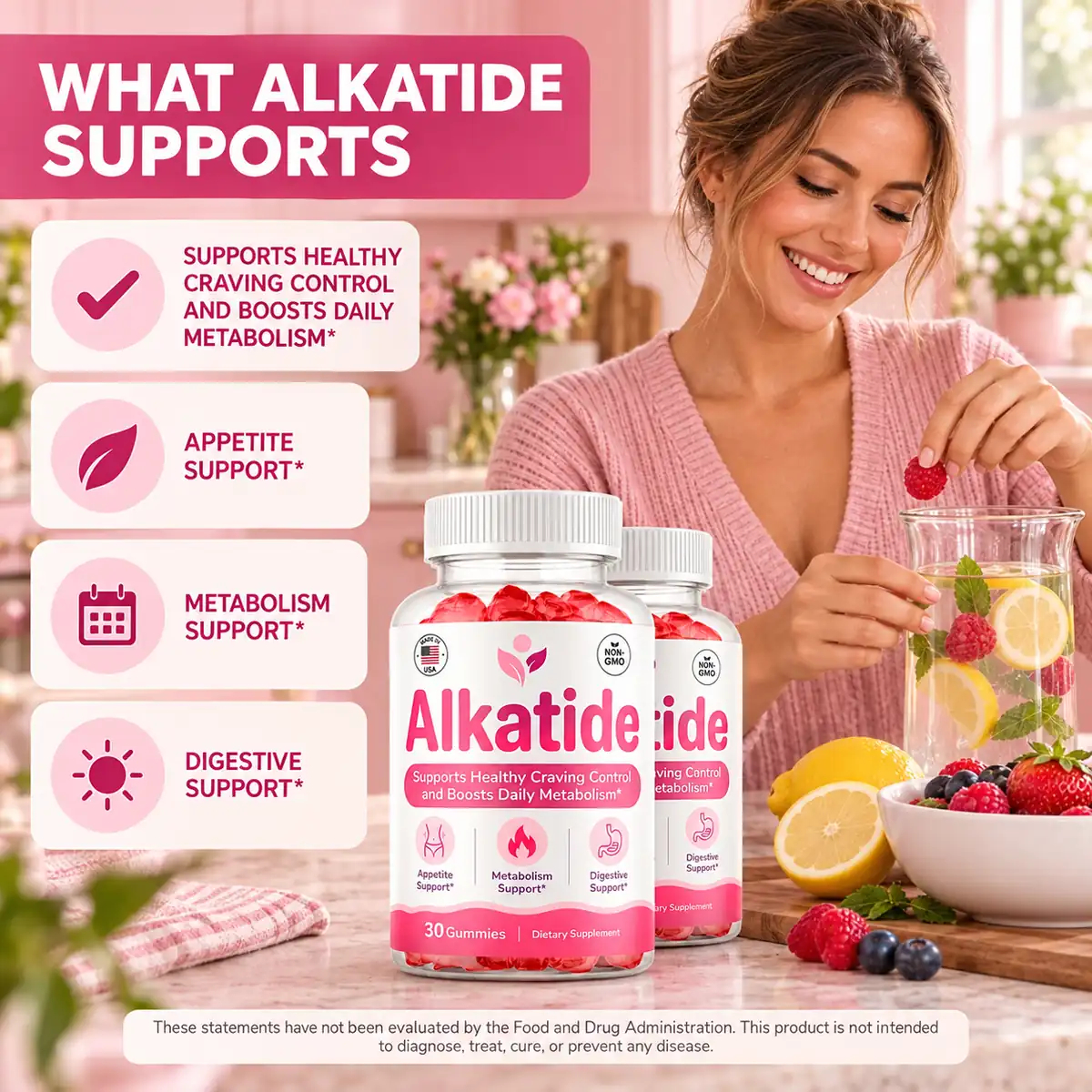
Claim one: AlkaTide supports healthy craving control
This is the headline, printed across the front of the bottle, and it is the reason most people in this category reach for apple cider vinegar at all.
What it means in practice is narrow and worth stating precisely: the label is not saying the gummy removes cravings. It is saying it supports craving control — the thing you are already doing. The timing is part of the claim. Taken 20–30 minutes before a meal, the serving sits at the point in the day the claim addresses, which is also how the research was run: Ostman 2005 gave vinegar with a bread meal and reported higher satiety alongside lower glucose and insulin responses.
The honest bound: that study used liquid vinegar. So did the gastric-emptying pilot. One AlkaTide gummy carries 250 mg of apple cider vinegar, a fraction of a tablespoon, and the finished gummy has never been tested as a product. A route that is plausible at one dose is not proven at a fraction of it.

What craving control looks like on an ordinary Tuesday
Not a transformation. A slightly easier decision at 3pm, made before you are standing in front of the cupboard rather than during. Reviewers who describe something describe that — a moment of pause, not the disappearance of appetite.
Of 1,025 written reviews, the most common wait before anyone reported noticing anything was three to four weeks, and 85% said they would recommend it. The three-star reviews on our reviews page say the opposite, and we left them in.
Claim two: AlkaTide supports appetite
Appetite support and craving control overlap, and the label lists them separately. Here is the difference as we read it.
Craving control is about the specific pull toward a specific thing. Appetite support is the broader one — how hungry you arrive at a meal. The published work that speaks to it is the same work: the bread-meal study measured reported satiety directly, and Hlebowicz 2007 looked at gastric emptying, which is the mechanism most often proposed to explain it. Food that leaves the stomach more slowly plausibly keeps you fuller for longer.
What nobody can tell you, including the manufacturer — is whether 250 mg in a chewable reproduces any of that. The how-it-works page walks the chain from acetic acid to appetite step by step and marks the exact link where the evidence stops.
Claim three: AlkaTide supports daily metabolism
“Boosts Daily Metabolism” is the second half of the front-of-bottle line, and it is the claim we would treat with the most caution.
Kondo 2009 is the trial everyone cites here: twelve weeks, obese Japanese adults, 15–30 ml of vinegar daily, with measured changes in body weight and body fat. It is a real study and it is the strongest thing this ingredient has. It is also 15–30 ml of liquid vinegar every day for three months, which is not what is in this bottle. Johnston 2004 reported improved insulin sensitivity to a carbohydrate meal, which is a metabolic finding rather than a metabolic-rate finding — those are different things, and marketing in this category routinely blurs them.
What “boosts metabolism” does not mean. It does not mean you burn more calories at rest because of a gummy. No supplement in this category has shown that at these doses. Read the claim as what it legally is: a structure/function statement about supporting an ordinary process, marked with an asterisk, not a promise of an outcome.
Claim four: AlkaTide supports digestion
The quietest claim on the label, and the one most likely to be noticed first — partly because the routine itself does some of the work. A full 8 oz glass of water twenty minutes before eating changes how that meal goes, independently of what is dissolved in your stomach.
We would rather say that than let you credit the gummy for all of it. If the routine helps, some of the help is the routine, and that is still a real benefit. It is just not evidence about acetic acid. The NIH National Center for Complementary and Integrative Health is a reasonable neutral place to read about supplement claims generally, and the NIH Office of Dietary Supplements publishes a short guide on what to expect from any supplement label.
What “supports” means on the AlkaTide label
Every claim on this bottle uses that word, and it is doing precise legal work rather than being vague marketing. Worth understanding, because it tells you the ceiling on what any supplement in the United States is allowed to say.
A structure/function claim describes support for a normal body process. A disease claim says a product treats, prevents or cures a condition. The second makes a product a drug, which requires approval this product does not have and has never sought. “Supports healthy craving control” is the first kind. “Cures obesity” would be the second, and no supplement may say it.
That is what the asterisk points at: the disclaimer that these statements have not been evaluated by the FDA. The FDA's own page on the category explains the line in a few paragraphs and is worth the read before you buy anything with an asterisk on it.
The practical translation. “Supports X” means: this may help something you are already doing. It does not mean it will do X for you, it does not promise a measurable outcome, and it is not a claim anyone had to prove before printing. Read it as a ceiling on the claim, not as a floor under the product.
Benefits AlkaTide does not claim, and why that matters
The absences on this label are informative, because every one of them is a claim you will find on competing bottles in the same category.
- ›No weight loss. Not on the label, not on this website. The manufacturer’s separate sales material uses weight-loss language and we have said on the ingredients page that the label does not support it.
- ›No fat burning. No mechanism is proposed and none is claimed. There is a whole article on that question: does apple cider vinegar burn fat.
- ›No blood sugar claim. This is the interesting one. The most-cited research on acetic acid is about post-meal glucose, and the label still does not make a blood sugar claim, because that territory sits close to a disease claim. A bottle that does make one is worth a second look.
- ›No detox, no cleanse, no energy. Words that mean nothing specific and are not on this panel.
- ›No timeframe and no amount. No “in 14 days”, no pounds. The FTC treats both as red flags and so should you.
Every AlkaTide claim against its evidence
| Label claim | Cited research | What that research used | In one gummy |
|---|---|---|---|
| Healthy craving control | Ostman 2005 | Liquid vinegar with a bread meal | 250 mg ACV |
| Appetite support | Hlebowicz 2007 | Apple cider vinegar, pilot study | 250 mg ACV |
| Metabolism support | Kondo 2009 | 15–30 ml daily for 12 weeks | 250 mg ACV |
| Digestive support | Launholt 2020 | Pooled safety and metabolic literature | 250 mg ACV |
These statements have not been evaluated by the Food and Drug Administration. This product is not intended to diagnose, treat, cure or prevent any disease. The FDA's own page on dietary supplements explains what that asterisk means and what it does not.

Every page, every journal post, the bottle facts and the ingredients go through review by Dr. Wendy Scinta, MD before they ship. We write these pages from the AlkaTide label and the distributor’s own paperwork, cite public research for apple cider vinegar, and print “not published” wherever a figure is not disclosed rather than estimating it. Where the manufacturer’s own sales page claims more than the label supports, we say so. Corrections are made on the page and the review date moves forward. Write to [email protected]. Last reviewed September 2026 by Dr. Wendy Scinta, MD.
Four AlkaTide claims, four asterisks, one honest page.
We have not added a fifth claim, and we have printed the dose gap under each one. Decide from that.
$294 for six bottles at $49 each
Order AlkaTide On The Official WebsiteFree US shipping · six digital bonuses · 60-day money-back guarantee · lot ALK-26/AL-1149